If your morning cup tastes more like a charred campfire log than a legendary fuel source, you’ve been led down the wrong trail. You crave that heavy, smoky body to kickstart your trek, but you’re tired of the scorched bitterness that leaves your stomach in knots by 9:00 AM. It’s a common trap because 82 percent of mass-market dark roasts are over-fired to hide low-quality beans. You deserve a french roast coffee blend that offers high-intensity depth without the acidic bite.
We’re going to unlock the secrets of the perfect dark brew, from the precise science of the second crack at 445 degrees Fahrenheit to the art of the oily finish. You’ll learn how to identify a premium blend that fuels your spirit rather than just burning your tongue. This guide covers everything from roast level chemistry to the best methods for brewing a bold cup on a windy ridge at 5,000 feet. Get ready to transform your morning ritual into a true Squatch-approved adventure.
Key Takeaways
- Understand the “Roast-Forward” philosophy that transforms oily, dark beans into the ultimate bold fuel for your outdoor adventures.
- Master the science of the “Second Crack” to see how intense heat unlocks legendary notes of dark chocolate and campfire smoke.
- Learn why a high-quality french roast coffee blend provides a smooth, low-acid experience that is easier on the stomach during long treks.
- Fine-tune your extraction with professional tips on water temperature and grind size to ensure a rich, never-bitter cup every time.
- Discover your new favorite companion for the wild by exploring our legendary Yeti and Eyeshine dark roast selections.
What is a French Roast Coffee Blend? Defining the Dark
French roast is the heavy-duty fuel for those who don’t fear the deep woods. It’s characterized by a shimmering, oily surface and a color so deep it rivals a moonless night in the Cascades. While lighter roasts brag about their volcanic soil or high altitude, a French roast tells a different story. It’s a roast-forward experience. This means the intense heat of the roaster takes center stage, overshadowing the subtle floral or fruity notes of the raw bean. You’re tasting the craft, the fire, and the smoke. It’s a bold choice for a bold day.
Choosing a french roast coffee blend over a single-origin dark roast is a tactical move for consistency. Single-origin beans often lose their unique identity under such high heat; they can become one-dimensional. A curated blend uses different bean varieties to build a sturdy flavor structure. One bean provides the heavy body while another adds a hint of sweetness to balance the char. This creates a reliable, legendary cup every single time you hit the trail. It’s about building a flavor profile that won’t quit, regardless of the batch.
This style didn’t start in a modern lab. It emerged from the 19th-century European cafe scene. By the 1850s, coffee drinkers in France and surrounding regions preferred their beans pushed to the limit. They wanted intensity. They wanted a brew that could stand up to heavy cream and sugar without flinching. This tradition traveled from the streets of Paris to the high peaks of the wilderness, becoming the gold standard for anyone who needs a serious kickstart to their morning.
The Visual Markers: Oil, Color, and Texture
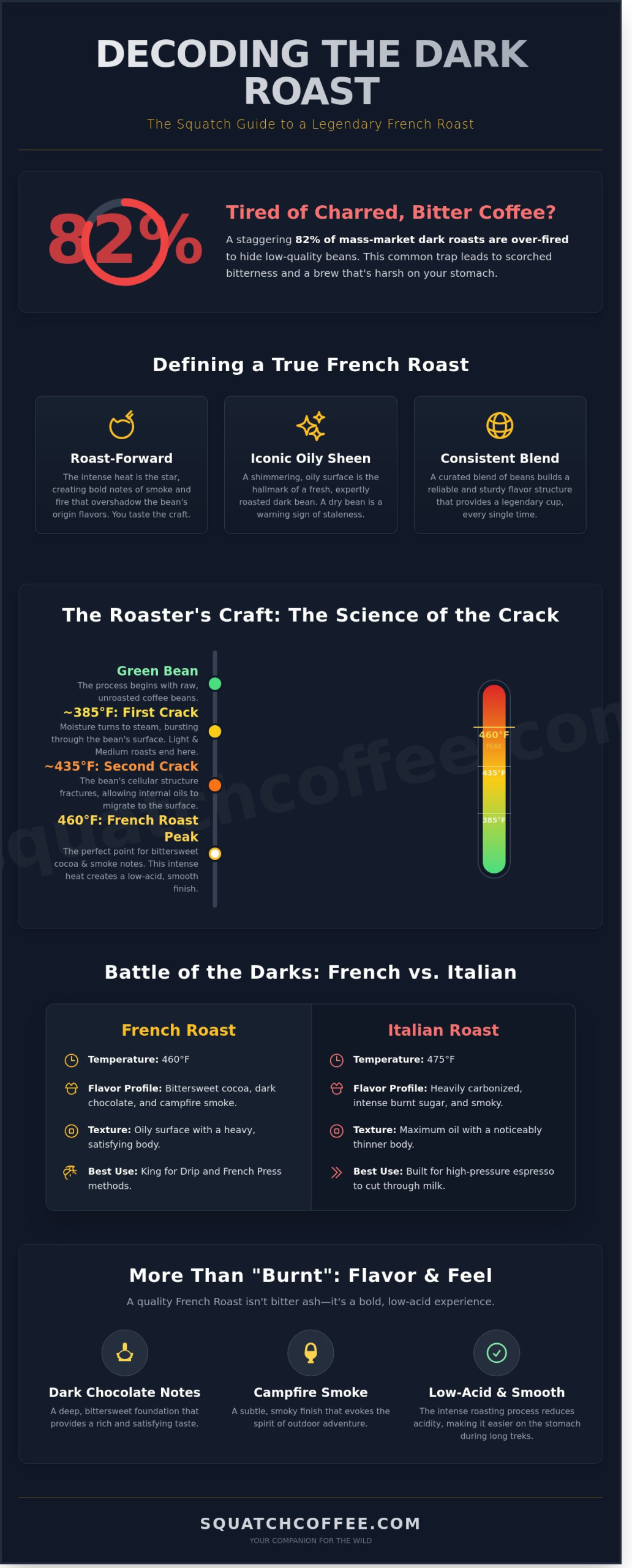
Look at the bean. If it’s matte or dry, it’s not a true French roast. During the Coffee roasting process, internal CO2 pressure forces lipids to the surface. This creates that iconic oily sheen. On the Agtron scale, a technical standard for measuring roast color, French roast typically hits between 25 and 35. It’s a shade often called Monk’s Brown. If you see a dark bean without oil, take it as a warning sign. It usually means the beans are stale. The oils have dried up or oxidized, leaving you with a flat, lifeless cup that won’t power your trek.
French Roast vs. Italian Roast: The Battle of the Darks
The difference between these two heavyweights is a matter of degrees. A French roast usually pulls from the heat at an internal bean temperature of 460°F. Push that bean just a little further to 475°F, and you’ve entered Italian roast territory. The flavor shifts significantly at this peak. French roast offers a bittersweet cocoa profile with a touch of campfire smoke. Italian roast goes further, leaning into carbon and intense burnt sugar notes. For your morning drip or a rugged pour-over, the french roast coffee blend is king. Save the Italian roast for your high-pressure espresso machines where that extra bite is needed to cut through steamed milk.
- French Roast: 460°F, bittersweet, dark chocolate notes, oily texture.
- Italian Roast: 475°F, carbonized, smoky, very thin body, maximum oil.
- Best Use: French roast excels in French Press and drip; Italian roast is built for espresso.
The Roaster’s Craft: Science of the Second Crack
Roasting a dark bean is a high-stakes game of heat and timing. You’re playing with fire to extract the boldest flavors hidden inside the seed. The process begins with the “First Crack” at approximately 385 degrees Fahrenheit. This is the audible sound of moisture turning to steam and bursting through the bean’s surface. Most light and medium roasts end here. To forge a legendary french roast coffee blend, we push much deeper into the furnace. We wait for the “Second Crack,” which occurs at roughly 435 degrees Fahrenheit. This isn’t just steam escaping. It’s the sound of the bean’s internal cellular structure actually fracturing. The physical walls of the bean break down, allowing internal oils to migrate to the surface.
According to the National Coffee Association’s guide to roasts, this intense heat triggers a chemical transformation called pyrolysis. During this phase, the organic material inside the bean begins to decompose under extreme temperatures. Sugars don’t just caramelize; they start to carbonize. This carbonization is what provides that signature smoky kick and heavy mouthfeel. If the roaster pulls the beans too early, the cup tastes thin. If they wait 15 seconds too long, the batch turns to ash. It requires a steady hand and a sharp ear to hit the peak of the profile.
Precision is why small-batch roasting is the only way to handle this style. We keep our batches under 60 pounds to ensure every single bean receives uniform heat. In massive industrial roasters, beans often suffer from “flash-burning.” This happens when the exterior of the bean chars at 450 degrees while the core remains underdeveloped. Small batches allow for a controlled 14 minute roast cycle that develops the bean from the inside out. Once the beans reach that perfect, shimmering oil sheen, we trigger the quenching process. We use high-velocity cooling trays to drop the bean temperature by 200 degrees in under 90 seconds. This rapid cooling locks in the volatile oils and prevents them from oxidizing or turning rancid before they reach your mug.
Selecting the Right Beans for the Heat
Not every bean can survive the trek through a 440 degree roaster. We specifically select high-altitude Arabica beans, like those found in our Yeti Blend, because they are physically denser than lowland crops. Beans grown at elevations above 1,500 meters develop slower, creating a tight cellular matrix that maintains its structure even as it carbonizes. This density is the 100 percent essential foundation for a dark roast. South American and Central American beans serve as the backbone for these blends. Their natural chocolate and nut base notes provide a sturdy platform that doesn’t vanish under the intense smoke of the roast.
The Art of the Blend Post-Roast
Consistency in the wild requires a different strategy. We utilize post-roast blending to ensure every cup hits the same mark. Roasting different bean varieties together often leads to uneven results because a dense Colombian bean roasts at a different rate than a softer Brazilian bean. By roasting each component to its individual peak and then mixing them, we balance a heavy, smoky base with a sweet, lingering top note. The Maillard reaction is the chemical bridge between the raw, green bean and the roasted perfection that fuels your morning. If you want a cup that stands up to the toughest trails, try our darkest forest blends for your next adventure.
Flavor Profile & Myth-Busting: Is it Just Burnt?
Some critics claim dark roasts are just a way to hide low-quality beans under a layer of ash. They’re wrong. A masterfully crafted French roast coffee blend is a deliberate choice, not a mistake. When the internal temperature of the bean hits 480 degrees Fahrenheit, the sugars don’t just melt; they transform. This process creates a flavor profile defined by dark chocolate, toasted walnuts, and a distinct campfire smoke. You’ll also find a heavy, syrupy mouthfeel that coats the palate. It’s thick. It’s bold. It feels like the liquid equivalent of a heavy wool blanket on a freezing night.
Bitterness often gets a bad reputation in the coffee world, but there’s a massive difference between roasty bitterness and poor extraction. Good bitterness provides structure, much like the tannins in a dry red wine. The science of coffee flavor shows that these deep, smoky notes come from the breakdown of chlorogenic acids during the second crack. If your cup tastes like a literal ashtray, the barista likely over-extracted it by using water above 205 degrees Fahrenheit or a grind that was too fine. When brewed correctly, that bitterness resolves into a pleasant, burnt sugar sweetness that lingers long after the last sip.
For the 7 out of 10 hikers who struggle with coffee-induced heartburn, the French roast is a hidden gem. A 2010 study published in Molecular Nutrition & Food Research discovered that dark roasted beans contain a specific compound, N-methylpyridinium (NMP), which tells the stomach to produce less acid. Light roasts are packed with bright, citric acidity that can irritate the gut during a steep climb. Switching to a darker blend provides a smoother experience, making it the superior fuel for a 10-mile trek through the backcountry.
The Caffeine Myth: Does Darker Mean Stronger?
Don’t confuse flavor intensity with caffeine content. Caffeine is surprisingly stable at high roasting temperatures. The real change happens in the bean’s physical structure. During the roast, beans lose about 18 percent of their mass but expand by nearly 20 percent in volume. If you measure your coffee by the scoop, a dark roast actually has less caffeine because the beans are larger and lighter. You’re fitting fewer beans into that scoop. If you want a real kick, weigh your grounds with a digital scale. The perceived energy boost from a French roast often comes from that intense, smoky aroma that wakes up your senses before the first drop hits your tongue.
Why French Roast is the Ultimate Campfire Companion
The wilderness isn’t a controlled laboratory. Out on the trail, you’re often dealing with fluctuating water temperatures and rustic gear. A French roast coffee blend is incredibly forgiving. While a delicate light roast might taste sour if your water drops below 195 degrees, the bold profile of a dark roast holds its ground. It stands up to the elements. It cuts through the smell of damp pine and crisp morning air, providing a sensory anchor for your campsite.
This blend was built for hearty pairings. It’s the perfect partner for a cast-iron skillet breakfast or a handful of trail mix. The smoky notes naturally complement the charred marshmallows of a midnight s’more. When you’re sitting on a fallen log at 5:00 AM, you don’t want a complex, tea-like brew. You want something rugged. You want a cup that tastes like the forest itself. That’s the Squatch way.
Brewing the Beast: Extraction Tips for Dark Blends
Taming a dark roast requires more than just boiling water; it demands a tactical approach to heat and timing. When you handle a heavy-hitting french roast coffee blend, you are dealing with beans that have spent extra time in the drum. This process makes the cell structure of the bean more porous and fragile. Because the coffee is so soluble, it gives up its flavor fast. If you treat it like a light roast, you will end up with a bitter, ashy mess that tastes like a forest fire instead of a forest adventure.
Temperature control is your first line of defense. Keep your kettle between 195°F and 200°F. While many people default to a rolling boil at 212°F, that extra 12 degrees will scorch the delicate oils that give dark blends their smoky sweetness. Lower temperatures ensure a smoother extraction, pulling out the cocoa and toasted walnut notes without the harsh carbon bite. Precision matters when you are brewing for the trail or the kitchen table.
Grind size acts as your secondary filter for flavor. For most dark roasts, a coarse grind resembling sea salt is the standard. This is especially true for immersion methods where the water and coffee sit together for several minutes. A fine grind provides too much surface area, causing the coffee to over-extract in seconds. Stick to a consistent, chunky grind to keep the profile clean and bold.
The bloom phase is where the magic happens. When you pour that first bit of water over fresh grounds, watch for the aggressive bubbling. Darker roasts trap more carbon dioxide during the long roasting process. A vigorous 30-second bloom indicates your beans were likely roasted within the last 14 days. It is a satisfying, visual proof of freshness that prepares the bed for a steady extraction. Don’t skip this step; let the beast breathe before you finish the pour.
For the ultimate “Squatchy” strength, follow the 1:15 golden ratio. Use 1 gram of coffee for every 15 grams of water. In a standard 32-ounce press, this equals about 60 grams of coffee. This ratio creates a heavy, syrupy body that provides enough fuel to power through a morning of wood-splitting or gear-packing. It is thick, honest, and unapologetically strong.
The French Press: The Natural Choice
The French Press is the ultimate tool for this roast. Start with your 1:15 ratio and 195°F water. Pour, stir once to submerge the grounds, and let it steep for exactly 4 minutes. Use a metal mesh filter rather than paper. Paper filters soak up the essential oils that define a french roast coffee blend, leaving the cup thin. Metal allows those oils to pass through, creating that signature velvety mouthfeel. Because dark beans can have up to 5% more surface oil than light roasts, clean your press with biodegradable soap every 3 uses to prevent old, rancid oils from ruining your next fresh pot.
Outdoor Brewing: Aeropress and Cowboy Coffee
When you are miles from the nearest outlet, the Aeropress is your best friend. Use the inverted method: flip the brewer upside down, add your coffee and water, and steep for 60 seconds before plunging. This creates a concentrated shot that rivals a campfire espresso. If you prefer the old-school way, Cowboy Coffee handles dark blends surprisingly well. Use the “boil and settle” method: add grounds to hot water, wait 4 minutes, and then splash a quarter-cup of cold water on top. The cold shock sinks the grounds to the bottom, leaving you with a clear, rugged brew. Check out our Brewing Guide for Your Next Oregon Camping Trip for more gear tips to master the wilderness.
Ready to test your skills in the wild? Grab a bag of our Dark Forest Blend and start brewing today.
Feelin’ Squatchy: Our Legendary French Roast Blends
Finding the right french roast coffee blend feels like tracking a legend through the thick brush. You know it’s out there. You can smell the smoke on the wind. Our Yeti Blend stands as the undisputed king of these woods. It’s our flagship dark roast, engineered for those foggy Oregon mornings when the world feels quiet and your goals feel massive. We push these beans right to the edge of the second crack to unlock a heavy, syrupy body that dominates your mug without losing its soul. It’s not just coffee; it’s the spark you need to start the engine.
Eyeshine Blend takes a different path through the timber. It captures the perfect balance of campfire smoke and a finish so smooth it’ll haunt your dreams. This blend is for the explorer who wants the intensity of a dark roast but demands a clean, lingering sweetness. If you prefer the deepest shadows of the forest, Howl in the Night is your match. This is a deep-roasted favorite for those who truly embrace the dark. We roast it longer and hotter to develop those oils that shimmer on the surface of the bean, creating a cup that’s bold, unapologetic, and fiercely caffeinated.
The Sasquatch difference starts with where we plant our feet. Every bag we ship comes from our small-batch roastery in Rockaway Beach, Oregon. We don’t do mass production. We don’t do stale. We roast in 25-pound increments to ensure every single bean receives the attention it deserves. This level of precision allows us to develop the complex sugars within the coffee without crossing the line into bitterness. You get the strength of the wild with the refinement of a master roaster.
From the Oregon Coast to Your Cup
Our commitment to small-batch roasting means you’ll never find ‘charcoal’ in your bag. Most mass-produced dark roasts are burnt to hide low-quality beans. We do the opposite. We use premium 100% Arabica beans that can stand the heat. The Pacific Northwest climate influences our entire process. The cool, salt-tinged air of the coast helps us control the cooling cycle with surgical precision, locking in flavors that other roasters lose to the wind. Our ‘Squatchy’ Guarantee is simple: freshness that fuels your next legend. We ship within 48 hours of roasting so your french roast coffee blend arrives at its absolute peak.
Join the Club: Never Run Out of Fuel
The trail is long and you can’t afford to run out of steam halfway through. Joining the Sasquatch Coffee Club is the smartest move for the dark-roast-only enthusiast. Members enjoy a 15% discount on every bag and the peace of mind that comes with automatic delivery. You can customize your subscription to match your pace, whether you’re brewing a single pot or fueling an entire expedition team. Don’t let an empty pantry stand between you and the summit. It’s time to upgrade your morning ritual with beans that are as tough and reliable as you are.
Fuel your next adventure with our Yeti Blend and experience the power of the PNW in every sip.
Fuel Your Next Great Discovery
Mastering the french roast coffee blend requires more than just high heat. It demands a deep respect for the second crack and a commitment to precision that most high-volume roasters simply can’t match. You now know that a dark roast shouldn’t taste like an old campfire; it should offer a heavy body and a complex, smoky finish that powers you through the toughest terrain. By adjusting your extraction and respecting the bean, you turn a simple morning ritual into a high-performance fuel source.
We take this craft seriously at our small-batch roastery in Rockaway Beach, Oregon. Our team monitors every flame to ensure the profile is bold but never burnt. More than 1,000 5-star reviews from fellow explorers prove that our legendary blends are built for the wild. Don’t settle for weak, watery cups when you can have the darkest brew on the map. We’ll even provide free shipping on all orders over $50 to help you stock up for the journey ahead. The wilderness is calling, and you’re going to need a strong cup to answer it.
Shop our Boldest French Roast Blends
Grab your gear, brew it bold, and keep the legend alive.
Frequently Asked Questions
Is French roast the strongest coffee?
French roast is the strongest in terms of flavor profile but not caffeine content. We roast these beans to an internal temperature of 480 degrees Fahrenheit to produce intense, smoky notes and a charred sweetness. It’s the ultimate fuel for those who want a bold, campfire-style cup that cuts through the morning mist.
What is the difference between French roast and Espresso roast?
French roast is a specific dark roast level while espresso is a roast profile or grind size intended for high-pressure extraction. A French roast typically stays in the roaster longer than an espresso roast to achieve a thinner body and more carbonized flavor. Our French roast hits the peak of the second crack to ensure every sip tastes like a wild adventure.
Does French roast coffee have more caffeine?
French roast actually contains slightly less caffeine than lighter roasts because the intense heat breaks down the caffeine molecules. The beans lose 15% of their mass during the 15 minute roasting process, which results in a lower caffeine concentration by volume. You’re drinking it for the legendary, robust flavor rather than a massive chemical spike.
Why is French roast coffee so oily?
High temperatures push the internal oils to the surface of the bean during the second crack. When the internal pressure reaches 250 PSI, the cell walls rupture and release these oils, creating a glossy sheen. These surface oils are responsible for the heavy mouthfeel and the bold, lingering finish that defines a true dark forest blend.
What is the best way to brew a french roast coffee blend?
The French Press is the superior method for brewing a french roast coffee blend because it preserves the essential oils. Use a coarse grind and water heated to exactly 200 degrees Fahrenheit for a 4 minute steep time. This immersion technique ensures you extract the full, rugged body without the paper filter stripping away the character of the beans.
Is French roast coffee low acid?
French roast is much lower in acidity than light or medium roasts because the long roasting cycle neutralizes organic acids. Most dark roasts maintain a pH level of 5.3, while lighter roasts often sit at a sharper 4.8. This makes it the perfect choice for hikers who need a stomach-friendly brew before hitting the steep trails.
How long does French roast coffee stay fresh?
French roast stays at its peak for 14 days after the roast date. Since the oils are already on the surface, they oxidize faster than those in a light roast. You’ll notice the legendary smoky aroma starts to dissipate after 21 days, so keep your beans in an airtight container to protect your fuel.
Can I use French roast for cold brew?
French roast makes an incredible cold brew concentrate with deep chocolate and toasted wood notes. Steep your coarse grounds for 18 hours in cold, filtered water to avoid extracting any bitter charcoal flavors. It’s a refreshing way to get that Squatch-level energy when the sun is beating down on the canyon floor.