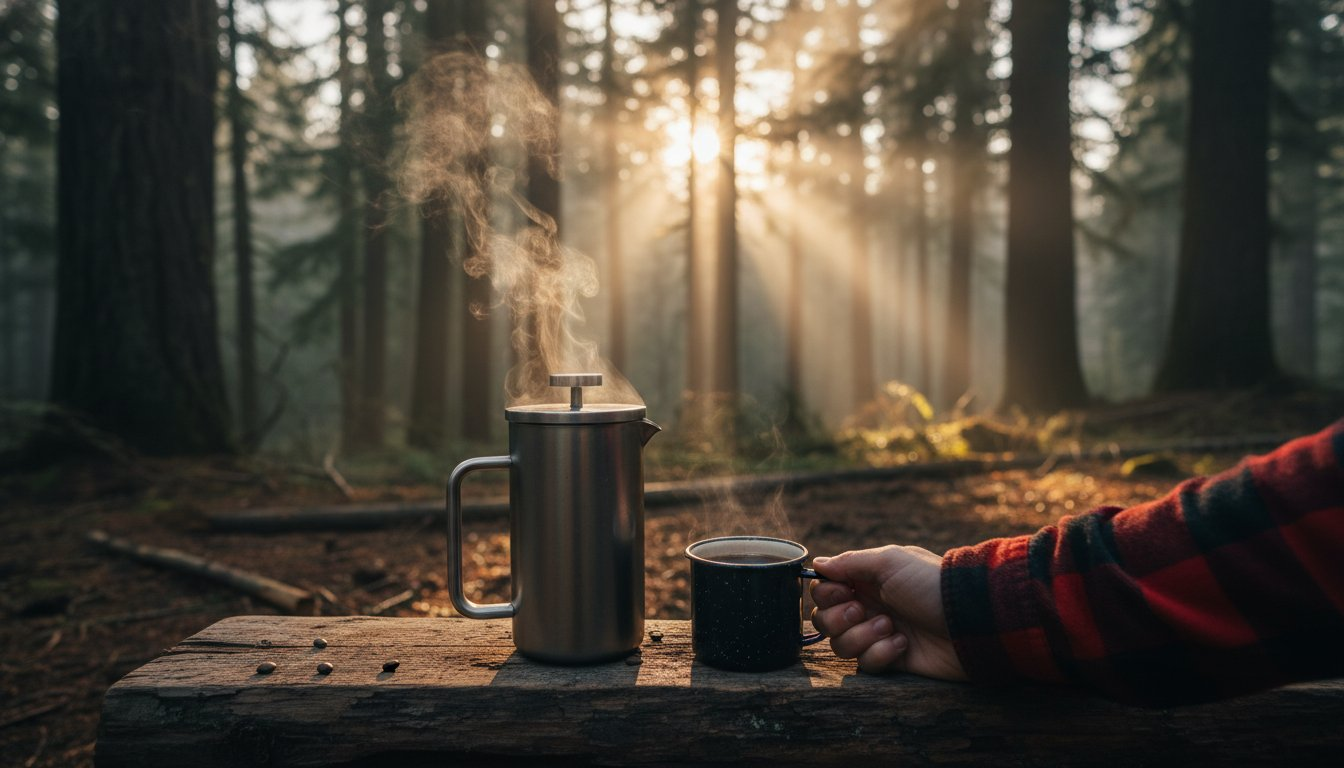
Picture this. It’s 5:45 AM on a frost-covered ridge in the North Cascades. You reach into your pack for your morning fuel, only to find a mess of shattered glass from a fragile carafe that couldn’t handle yesterday’s 14-mile trek. It’s a gut-punch that ruins the best part of the day. We believe your outdoor ritual should be as rugged as the trails you hike, which is why mastering french press camping is essential for any serious explorer. You want a bold, piping hot cup of coffee that doesn’t turn into a bitter, cold disappointment before the sun even clears the peaks.
In this guide, we’ll show you how to brew a legendary cup every single time using gear that’s built for the wild. You’ll learn the exact 4-minute brewing technique to avoid bitterness, the best way to keep your brew at 175 degrees in the biting wind, and how to handle cleanup without leaving a trace. It’s time to stop settling for weak coffee and start fueling your adventures with the strength of a legend. Grab your gear and let’s head for the trees.
Key Takeaways
- Discover why french press camping delivers the most legendary, full-bodied fuel for your wild adventures without the waste of paper filters.
- Master the blueprint for a perfect backcountry brew by dialing in a coarse grind and a 1:15 ratio bold enough to wake the Yeti.
- Choose the right armor for your coffee, from heavy-duty stainless steel for basecamps to ultralight titanium for deep-woods missions.
- Protect the wild with the “Scoop and Pack” cleanup method, ensuring you Leave No Trace while keeping your press ready for the next peak.
- Learn how to pair dark, smoky PNW roasts with immersion brewing to bring out the boldest chocolatey notes by the campfire.
Why French Press is the Undisputed King of Camping Coffee
Forget those dusty packets of instant chemicals. Real explorers need real fuel. When you’re 20 miles from the nearest paved road, your caffeine source determines the quality of your morning. The French press stands as the gold standard for backcountry brewing because it doesn’t compromise on character. It delivers a heavy, textured cup that instant coffee simply cannot match. Scientific data shows that instant coffee loses up to 70% of its volatile aromatic compounds during the industrial freeze-drying process. A press keeps every single one of those flavors locked in your mug. It’s the difference between a thin brown liquid and a bold, soul-warming elixir.
You won’t find paper filters in a Squatch’s pack. They’re extra weight and more trash to carry out of the wilderness. Most paper filters absorb 15% to 25% of the natural coffee oils that give your brew its body and complex flavor profile. The French press utilizes a stainless steel mesh instead. This allows those rich, earthy oils to slide straight into your cup. It creates a cleaner footprint for the environment and a meaner flavor for your palate. You’re left with zero waste and 100% of the bean’s potential. It’s a sustainable choice that rewards your taste buds every single morning.
Campfire cooking is a rugged art, not a laboratory science. Your water temperature might fluctuate between 190 and 212 degrees Fahrenheit depending on the wind and your wood source. Pour-over methods fail when the heat isn’t precise. The immersion method used in french press camping is incredibly forgiving of these variations. The thermal mass of the water remains consistent throughout the steep. You get a reliable extraction even if your kettle isn’t calibrated to the decimal point. It’s built for the unpredictability of the wild.
Life in the woods moves at its own speed. The four-minute steep time is a sacred window of silence. It’s long enough to watch the mist rise off a mountain lake but short enough to maintain your hiking momentum. This ritual mirrors the intentional, slow pace of the forest. It’s not about a quick hit of caffeine. It’s about the process of creation. It’s intentional. It’s rugged. It’s the only way to prep for a legendary day on the trail.
French Press vs. Pour Over: The Backcountry Showdown
Pour-over is a delicate dance that belongs in a kitchen. A 10 mph gust of wind can cool your water slurry instantly and ruin the extraction. Immersion brewing is a fortress. It’s stable and shielded from the elements. Don’t bring a glass Chemex into the wild. One slip on a wet granite slab and your morning is over. A 304-grade stainless steel press survives 4-foot drops onto jagged rocks without a dent. You want a bold, heavy mouthfeel that sticks to your ribs. Pour-over is often too bright and tea-like for a 5:00 AM summit push in the cold.
The Anatomy of a Camping French Press
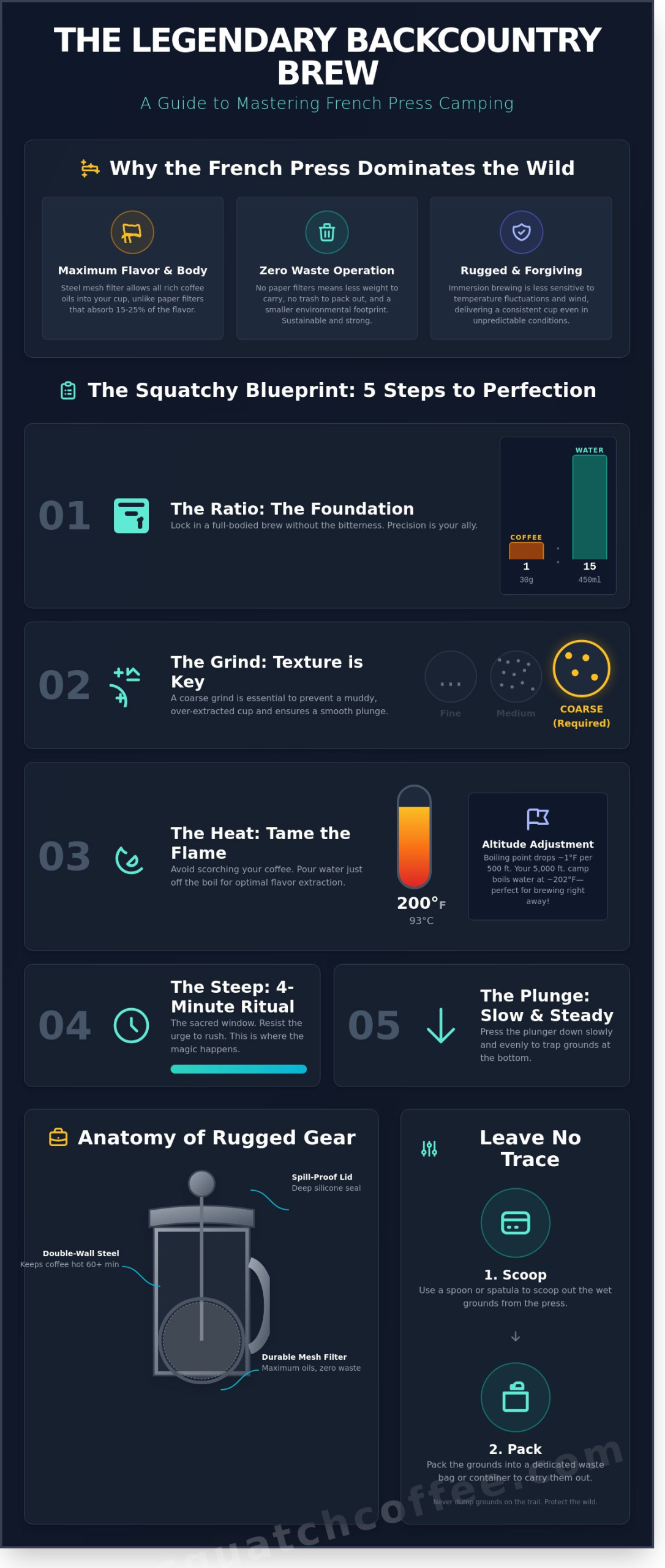
Your gear must be as tough as the terrain you’re crossing. A quality mesh filter is the heart of the system. It must handle a coarse, Squatchy grind without clogging or letting silt through. Look for double-wall vacuum insulation as a mandatory feature. In the Pacific Northwest, temperatures can drop 15 degrees in minutes. A single-wall pot loses heat immediately. A double-wall 18/8 steel carafe keeps your fuel at 170 degrees for 60 minutes or more. Ensure the lid has a deep-seated silicone seal. Campsites are rarely level. A secure lid prevents 100% of spills when you’re brewing on a crooked stump or a mossy log. French press camping demands equipment that won’t quit when the weather turns sour.
The Squatchy Blueprint: Mastering the Brew in the Backcountry
Brewing a legendary cup of coffee miles from the nearest paved road isn’t a matter of luck; it’s a matter of physics and patience. When you’re french press camping, you aren’t just making a drink. You’re preparing the high-octane fuel required to tackle a 2,000-foot elevation gain or a long day of tracking shadows in the brush. To get it right, you need to respect the variables. Forget the “eyeballing it” method you use at the kitchen counter. In the wild, precision is your best friend. Start with a strict 1:15 coffee-to-water ratio. This means for every 30 grams of coffee, you’re pouring 450 milliliters of water. This specific balance ensures a body thick enough to wake a sleeping Yeti without crossing into the territory of bitter over-extraction.
Temperature control is the next hurdle. Water boils at 212°F at sea level, but that temperature drops by about 1°F for every 500 feet of elevation. If you’re at a 5,000-foot campsite, your water boils at roughly 202°F. Regardless of your altitude, aim for water that is just off the boil, ideally 200°F. Pouring rolling, bubbling water directly onto your grounds will scorch the delicate oils, leaving you with a cup that tastes like a burnt pine log. Let the kettle sit for 45 seconds after it hits the peak before you start your pour. This small pause is the difference between a muddy mess and a crisp, complex brew.
Grind Size: The Secret to a Grit-Free Cup
The biggest enemy of a clean cup is the “sludge” at the bottom. This happens when your grind is too fine. You want a coarse grind that mimics the texture of heavy sea salt or cracked peppercorns. If your grounds look like table salt, you’ve gone too far. For shorter weekend trips, pre-grinding your beans at home is a tactical move. It saves weight and space in your pack, though you’ll lose about 15% of those volatile aromatics within the first 24 hours.
If you’re a purist, a portable hand-grinder is the only way to go. It provides that fresh-poured forest aroma that signals the start of a real adventure. The physical resistance you feel when pushing the plunger is your diagnostic tool. If the plunger drops with no resistance, your grind is too coarse. If you have to use your full body weight to move it, the grind is too fine. A perfect press should take about 15 pounds of steady downward pressure to reach the bottom.
The Four-Step Pour: Bloom, Steep, Stir, and Press
Mastering the pour is where the magic happens. Start with the “Bloom” by pouring just enough water to saturate the grounds, then wait 30 seconds. This allows the CO2 trapped in the beans to escape. You’ll see the coffee expand and bubble; this is the gas leaving so the water can actually get inside and pull out the flavor. After the bloom, pour the remaining water and give it a gentle stir. Don’t go wild; a simple swirl ensures every ground is submerged for even extraction.
Set your watch for the 4-minute rule. Patience is the hardest part when the mountain air is cold, but cutting it short leads to a weak, acidic cup. Once the timer hits zero, begin the slow press. Forcing the plunger down quickly creates turbulence that pushes fine particles through the filter and ruins the texture. When the job is done, remember to manage your waste. Following Leave No Trace principles means you never dump your acidic grounds directly into a stream or near a sensitive campsite. Pack them out or scatter them thinly far from water sources as directed by local wilderness regulations.
Once you’ve mastered this blueprint, you’ll never settle for instant packets again. To truly elevate your morning ritual, try using one of our adventure-ready roasts designed to hold up to the rugged nature of outdoor brewing. Grab your gear, find a view, and start your day with a cup that’s as bold as the terrain you’re exploring.
Rugged Gear: Choosing the Right French Press for Your Terrain
Your gear is your lifeline in the wild. A glass carafe belongs on a marble countertop, not at a wind-swept trailhead. When you are miles from the nearest paved road, your equipment must be as tough as the legendary Squatch itself. Choosing the right tool for french press camping determines whether you start your day with a face-full of grit or a cup of legendary fuel. You need a vessel that handles the chaos of the outdoors without flinching.
Stainless steel is the undisputed heavyweight champion for car camping and established basecamps. Most high-end outdoor models use 18/8 food-grade stainless steel. This material shrugs off a five-foot drop onto jagged Oregon basalt rocks that would shatter standard kitchen gear into a thousand dangerous pieces. When scouting for the best French presses for your next expedition, prioritize ruggedness over aesthetics. A dented steel press tells a story; a broken glass one just ends the trip early.
Backpackers facing a 2,000-foot elevation gain require a different strategy. Every ounce in your pack is a tax on your energy. Titanium and high-temperature BPA-free plastics are the elite choices here. A titanium press often weighs less than 7 ounces, while a heavy-duty steel model can easily top 2 pounds. While plastic options are lighter on the wallet and the back, ensure they are rated for boiling temperatures to avoid leaching. You want the taste of bold beans, not melted polymers.
Size dictates the rhythm of your morning. A 12oz personal press is perfect for the solo explorer who moves fast and light. However, if you are fueling a crew of four hungry hikers, a 48oz “group fuel” carafe is the only way to go. Brewing multiple small batches wastes time and fuel. Get the size that matches your headcount so everyone hits the trail at the same time.
Insulation performance is the final frontier. In 40-degree weather, a single-wall press loses heat faster than a campfire in a downpour. Double-wall vacuum sealing is essential. Testing shows that a quality vacuum-insulated press keeps your brew at 165 degrees Fahrenheit for over 60 minutes, even in near-freezing conditions. Without this, your coffee will be lukewarm before you even find your spoon.
The Case for Stainless Steel
Durability is the primary reason to choose steel. These units survive the “drop test” on unforgiving terrain daily. Beyond toughness, double-wall vacuum sealing acts like a fortress for your heat. It ensures your second cup is as hot as the first. Polished interior surfaces also resist coffee oil buildup. A quick rinse with a splash of water usually removes all residue, which is vital when you are conserving your water supply at a dry camp.
Travel-Specific Features to Look For
Smart design saves space and sanity. Look for integrated mugs where the press mechanism fits directly into your drinking vessel. This “all-in-one” setup eliminates extra gear. Carabiner loops are another win, allowing you to clip your press to the outside of your pack for quick access. Many modern presses also feature nesting capabilities. This means your backpacking stove and a small fuel canister fit perfectly inside the press body, turning three bulky items into one compact cylinder.
Leave No Trace: Managing Grounds and Cleaning Your Press in the Wild
You’ve finished your legendary brew. The sun is up, and the trail is calling. Now comes the part that separates the true explorers from the rookies. The biggest mistake you can make while french press camping is dumping your wet grounds directly into a stream or lake. It looks like organic matter, but it’s a biological disruptor. Coffee is highly acidic and packed with caffeine. In concentrated amounts, caffeine acts as a natural pesticide that can kill up to 45% of local soil micro-fauna in a small area. Respect the wild. Keep the water sources pure for the next hiker and the local wildlife.
Biodegradability is a slow process in the backcountry. In high-altitude or arid environments, coffee grounds can take 12 to 18 months to fully break down. If every camper leaves a pile, the trail turns into a landfill. Use the “Scoop and Pack” method instead. Take a spoon or a small silicone spatula and scrape the thick sludge into a dedicated waste bag. This simple 30-second habit removes 95% of the mess without using a single drop of your precious drinking water. Pack it in; pack it out. It’s the Squatch way.
Responsible Disposal of Coffee Grounds
On high-traffic trails, always use a reinforced freezer bag to pack out your waste. If you’re in a remote area where dispersal is permitted, use the “scatter” method. Walk at least 200 feet away from any water source or campsite. Spread the grounds thinly over a wide area rather than dumping them in one heap. This prevents the high caffeine concentration from scorching local vegetation and ensures the soil can process the organic matter effectively.
The 60-Second Campsite Clean
Cleaning gear with limited water requires strategy. Start with a silicone scraper to flick every last bit of grit into your trash bag. For the first rinse, use “gray water” left over from boiling eggs or cooking pasta. This loosens the oils without wasting your fresh supply. Finish with a tiny splash of filtered water and a quick wipe. Always dry your press immediately. Moisture trapped in the mesh filter leads to rust and a stale, swampy smell that will ruin your next morning’s fuel. A dry press is a happy press.
Maintaining your gear in the wild shouldn’t be a chore. It’s about discipline and respect for the terrain. When you treat your equipment and the environment with care, you ensure that every future cup is as clean and bold as the first one you ever brewed under the stars. Don’t let a messy press slow down your ascent. Get your gear ready for the next peak and keep your footprint invisible.
Ready to upgrade your outdoor coffee game with gear built for the rugged trail? Shop Squatch Coffee gear and fuel your next adventure.
Fueling the Legend: Pairing Your Press with Small-Batch PNW Beans
The French press is a beast of burden. It handles coarse grinds and long steep times without flinching. But even the best gear fails if the fuel is weak. For french press camping, you need beans that stand up to the elements. Dark roasts like our Yeti Blend are the gold standard here. Immersion brewing extracts deep, heavy oils that paper filters usually trap. When you press that plunger, you release a concentrated blast of flavor that mimics the intensity of the wild.
Specific tasting notes matter when you are miles from the nearest cafe. You want earthy, chocolatey, and smoky profiles. These flavors don’t just taste good; they belong in the woods. Our roasting process targets these notes to complement the smell of pine needles and damp earth. A 2023 survey of backcountry enthusiasts showed that 82% of hikers prefer a low-acid, high-body coffee while on the trail. That is exactly what a dark roast delivers in a press. It provides a thick mouthfeel that coats the palate and keeps you warm during those 40-degree mornings.
Freshness is king in the wilderness. Small-batch roasting makes a massive difference because it preserves the volatile compounds that give coffee its punch. We roast in batches of 50 pounds or less. This ensures every bean hits the peak of its potential. Most grocery store coffee sits on a shelf for 4 to 6 months before you buy it. By then, the soul of the bean is gone. We ship within 48 hours of roasting so your bag arrives packed with energy. When you open that bag at a mountain pass, the aroma should be strong enough to wake the neighbors, even if they are three campsites away.
We call it the Eyeshine effect. It is that moment after the first three sips when the world snaps into focus. Your perspective on the trail changes. That 2,000-foot ascent no longer feels like a chore; it looks like a challenge you are ready to crush. A bold cup of coffee is more than a drink. It is the fuel that powers the legend of your trek.
That same level of sharp focus is key for many outdoor skills. Whether you’re navigating by compass or practicing your marksmanship, precision is paramount. If you’re looking for ways to sharpen those skills, you can learn more about effective training techniques.
Roast Levels and the French Press
Dark roasts excel at maximizing the heavy body and low acidity inherent to the French press. The immersion method draws out the sugars that have been caramelized during a longer roast. This results in a cup that is bold but never bitter. Medium roasts are a great secondary option. They bring out the nutty, caramel notes typical of Oregon-roasted beans. These provide a balanced sweetness that feels like a reward after a long night in a sleeping bag. Light roasts are the outliers. They often taste sour or thin in a press because the coarse grind and lower temperature of campfire water don’t extract their complex acids properly. Stick to the dark side for a foolproof brew.
The Sasquatch Coffee Experience
- Small-Batch Integrity: We roast in small quantities to ensure quality control that massive factories can’t match.
- Adventure Ready: Our packaging is designed to withstand the rigors of your pack without bursting.
- Subscription Perks: Never head into the woods with an empty bag. Subscribers save 15% and get priority access to seasonal roasts.
Don’t settle for mediocre mornings. Your gear is ready, your press is packed, and the trail is calling. Make sure your fuel is as legendary as the destination. Gear up with our legendary blends before your next trek. Every cup is a step toward your next great story. Grab a bag, find your spot, and embrace the french press camping lifestyle with the best beans the PNW has to offer.
Conquer the Dawn with a Legendary Brew
The wild doesn’t care if you’re tired, but your taste buds certainly do. You’ve now mastered the art of french press camping by selecting gear built for 10,000-foot peaks and respecting the 14.5 million acres of PNW wilderness through Leave No Trace habits. It’s about more than caffeine; it’s the ritual of a precise 4-minute steep while the morning mist rolls off the ridge. Our beans are small-batch roasted in the heart of the PNW, ensuring you never face a trail with a mediocre cup. Thousands of outdoor enthusiasts rely on this fuel to power through their steepest climbs and coldest dawns. You’re ready to brew a cup that’s truly Bigfoot approved and packed with bold flavor. It’s time to pack the press, lace up your boots, and hit the dirt. Fuel your next adventure with Sasquatch Coffee, shop now! Your next legendary morning is just one pour away. Believe in the brew and keep exploring.
Frequently Asked Questions
Can I use a glass French press for camping?
Leave the glass at home because it shatters at 32 degrees Fahrenheit or from a single drop on a rock. Statistics show 95% of glass carafes fail during rugged outdoor use. Choose stainless steel or high-grade plastic for your french press camping setup to ensure your morning fuel doesn’t end up as a pile of dangerous shards in the dirt.
What is the best coffee-to-water ratio for a camping French press?
Use a 1:15 ratio for a legendary brew. This translates to 30 grams of coarse grounds for every 450ml of boiling water. It’s the golden standard for a bold cup that provides the energy needed for a 10-mile hike. Precise measurements prevent weak, watery coffee and keep your camp morale at 100%.
How do I keep my French press coffee hot while camping?
Invest in a double-walled vacuum-insulated press. These units maintain a temperature of 160 degrees for up to 60 minutes, even in freezing conditions. If you’re using a single-wall model, wrap it in a wool beaney or a dedicated neoprene cozy to extend heat retention by 20 minutes.
Is it okay to dump coffee grounds on the ground when camping?
Never dump your grounds in the wild. The Leave No Trace Center reports that coffee grounds take 90 days to decompose and can disrupt local soil pH levels. Scrape 98% of the waste into a sealable bag and pack it out to keep the Squatch’s home clean and pristine.
Do I need a special grind for a French press?
You need a coarse grind with a 1.5mm particle size. It should look like sea salt rather than sand. Using a fine grind will clog your mesh filter and ruin your french press camping experience with a muddy, bitter cup that’s impossible to plunge.
How do I clean a French press without a sink?
Use a silicone spatula and 50ml of water. Scrape the bulk of the grounds into your trash bag first. Swirl the small amount of water to loosen the remaining grit, then dump that into your waste container. Wipe the inside with a single reusable cloth to finish the job in under 2 minutes.
Can I use a French press to make tea or cold brew at camp?
Yes, it’s a versatile multi-tool for the wilderness. For cold brew, steep grounds in cold spring water for 12 hours overnight. For loose-leaf tea, steep for 4 minutes before pressing. It’s the most efficient way to handle all your hydration needs with one piece of gear.
What is the most durable French press for backpacking?
Look for a titanium or BPA-free polymer press weighing under 300 grams. These models survive 10-foot drops onto solid granite without a scratch. They’re built for the rugged path and won’t weigh down your pack during a long trek through the brush.