By Gunnar Monson | Founder, Sasquatch Coffee Company
Nearly 60 years after a mysterious figure crossed a Northern California creek bed, the footage remains a key reference. However, even if the Patterson-Gimlin film is a hoax, it does not end the discussion about Capturing Bigfoot. This ongoing discussion touches on methods for validating evidence and eyewitness accounts.
Moreover, a single clip cannot settle the existence question, since sightings and evidence keep the debate alive. Nevertheless, I don’t think so, because new findings and careful research sustain the discussion for researchers and enthusiasts.
The Film That Helped Start It All
On October 20, 1967, Roger Patterson and Bob Gimlin captured approximately one minute of footage along Bluff Creek in Northern California. The film showed a large, hair-covered, seemingly bipedal creature walking across a sandbar before disappearing into the woods.
The figure, eventually nicknamed “Patty,” would become arguably the most recognizable image in Bigfoot history.
For nearly six decades, researchers, skeptics, scientists, filmmakers, and curious observers have debated what the camera actually captured.
Was it an undiscovered North American primate? A person wearing an elaborate costume? Or something else?
Now, a controversial new documentary is attempting to answer that question once and for all.
For me, however, the story is considerably more personal.
I grew up in Oregon, where stories of Sasquatch have long been part of the regional culture. As a kid, I was fascinated by books about mysterious creatures and television programs like In Search Of…, hosted by Leonard Nimoy.
The Patterson-Gimlin footage was a big part of that fascination.
There was something extraordinary about watching that mysterious figure stride across the creek bed, turn toward the camera, and continue into the forest.
It sparked my imagination and helped fuel an interest in Bigfoot that has stayed with me for most of my life.
That interest eventually led me into Bigfoot research and, years later, played a role in the creation of Sasquatch Coffee Company.
But here’s the important part: My interest in Bigfoot was never dependent on the Patterson-Gimlin film being genuine.
And it certainly isn’t today.
Enter Capturing Bigfoot
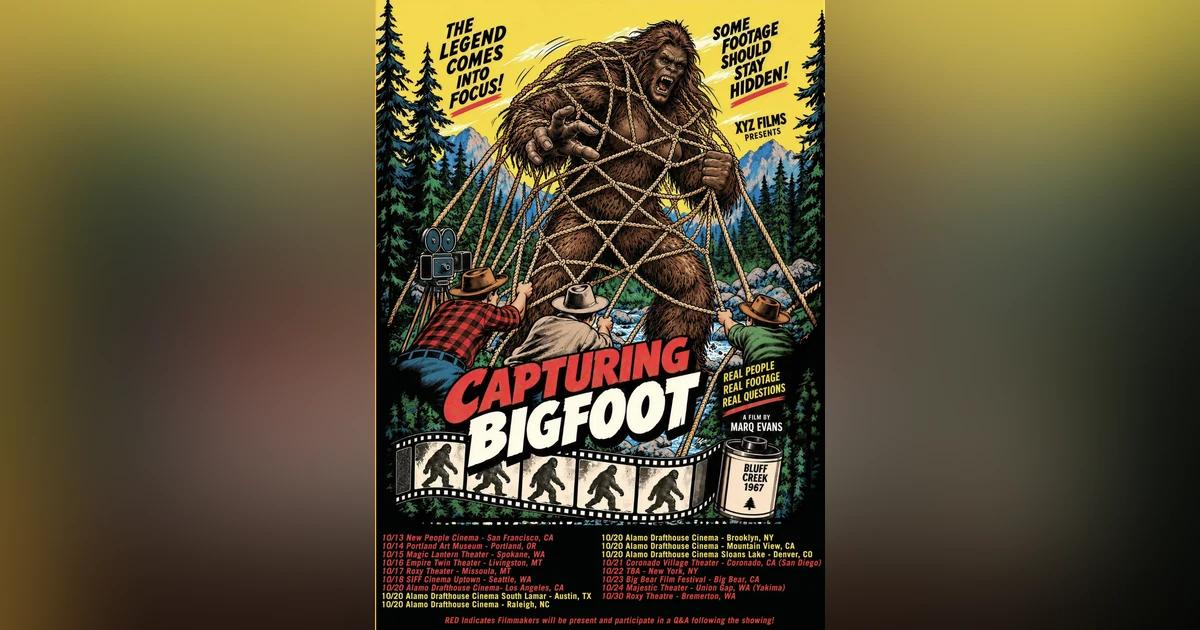
Released in October 2026, Capturing Bigfoot is directed by filmmaker Marq Evans. Additionally, it takes another look at the events surrounding that famous day in 1967.
The documentary presents what its filmmakers contend is compelling new evidence that the Patterson-Gimlin footage was staged.
Among its most significant revelations is a previously unseen reel of 16mm film, reportedly discovered after spending decades in a safe. The documentary suggests the footage may show an earlier attempt or rehearsal involving a Bigfoot costume.
The film also features interviews with people connected to Roger Patterson, including his son, Clint Patterson, and individuals who have long maintained that the famous footage was a hoax.
Bob Heironimus, who has claimed for years that he was the person inside the Bigfoot costume, is also featured.
Perhaps most notably, the documentary presents testimony from members of Patterson’s family supporting the claim that the original film was staged.
For some viewers, this evidence may be enough to close the book on the Patterson-Gimlin film.
Others have raised questions about the newly discovered footage, its connection to the 1967 film, and whether the documentary’s conclusions are fully supported by independently verifiable evidence.
Those are legitimate questions worth examining.
I believe anyone seriously interested in Bigfoot research should be willing to consider evidence that challenges long-held assumptions.
If the Patterson-Gimlin film was a hoax, then that’s something we should acknowledge.
But does that mean Bigfoot doesn’t exist?
Absolutely not.
One Film Is Not the Entire Case for Bigfoot
This is where I think the conversation surrounding Capturing Bigfoot risks losing perspective.
For decades, the Patterson-Gimlin footage has occupied an almost mythical position within Bigfoot research.
Some researchers have treated it as the strongest visual evidence ever recorded. Others have built extensive arguments around the creature’s proportions, apparent muscle movement, stride, and anatomy.
And skeptics have spent just as much time attempting to explain how the film could have been manufactured.
But here’s the thing.
The Patterson-Gimlin film is only one piece of a much larger puzzle.
Reports of large, unidentified, human-like creatures in North America didn’t begin in 1967.
Stories and traditions involving wild, hairy, or human-like beings existed among Indigenous communities long before Roger Patterson ever picked up a movie camera. Those traditions are diverse and should not all be treated as descriptions of the same creature.
There were also newspaper accounts, alleged encounters, and mysterious footprint discoveries well before the Bluff Creek footage.
And reports didn’t stop after 1967.
Over the decades, witnesses have continued describing encounters with large, upright, hair-covered figures in forests, mountains, and remote areas across North America.
Researchers have documented alleged footprints, collected witness testimony, examined possible hair samples, investigated unusual sounds, and explored reported encounters in the field.
None of this establishes that Sasquatch exists. Much of the material remains disputed, and some reports undoubtedly involve misidentifications, exaggerations, or outright hoaxes.
But the broader question can’t be answered simply by declaring one famous piece of footage fraudulent.
Even if every second of the Patterson-Gimlin film were proven to be staged, it wouldn’t automatically explain every other report or experience.
Those would still need to be examined on their own merits.
Bigfoot Research Should Never Be About Protecting a Belief
One thing I’ve learned over the years is that Bigfoot research attracts people with very different motivations.
Some are convinced these creatures exist.
Others are skeptical but curious.
Some have had personal experiences they cannot explain.
And many, like me, have simply spent much of their lives fascinated by the possibility that something extraordinary might still be hiding in the forests of North America.
I don’t believe good research should begin with the assumption that Bigfoot must exist.
But I don’t believe it should begin with the assumption that Bigfoot cannot exist, either.
It should begin with questions.
What happened? What evidence is available? Can it be verified? Are there reasonable alternative explanations?
And perhaps most importantly, are we willing to change our conclusions when better information becomes available?
That’s why I don’t see Capturing Bigfoot as something the Bigfoot community should automatically reject.
If the filmmakers have uncovered credible evidence that the Patterson-Gimlin footage was staged, that evidence deserves serious consideration.
We should be interested in discovering the truth, even when it challenges something we’ve believed for decades.
At the same time, extraordinary claims of a definitive debunking deserve careful scrutiny, just as extraordinary claims of an undiscovered primate do.
Neither side should get a free pass.
What If Patty Really Was Just a Guy in a Suit?
Let’s entertain the possibility.
Suppose the documentary is correct.
Suppose Roger Patterson staged the entire sequence in 1967.
Suppose the famous figure walking across Bluff Creek really was someone wearing a costume.
What changes?
For one thing, we’d have a better understanding of one of the most influential films in cryptozoological history.
Researchers would need to reconsider any conclusions built specifically upon that footage.
And an important chapter in Bigfoot history would look very different.
But what wouldn’t change?
The many decades of reports and investigations that exist independently of the film.
The questions surrounding alleged footprints and other physical traces.
The experiences of people who sincerely believe they’ve encountered something unusual in the wilderness.
And the possibility, however unproven, that there are still discoveries to be made.
Of course, eyewitness accounts aren’t scientific proof, and unexplained evidence doesn’t automatically point to Sasquatch.
But neither does exposing one potential hoax provide a universal explanation for an entire subject.
Debunking the Patterson-Gimlin film would debunk the Patterson-Gimlin film. It would not, by itself, debunk Bigfoot.
That distinction matters.
The Mystery Is Bigger Than the Movie
As someone who has spent much of his life interested in Sasquatch, I’ve seen plenty of supposedly definitive revelations come and go.
New photographs. New videos. Alleged DNA evidence. Dramatic witness statements. Confessions of hoaxes.
Each seems to generate its own wave of excitement, controversy, and debate.
And somehow, the larger mystery remains.
Maybe the answer will eventually come from a clear, independently verified piece of physical evidence.
Maybe new technology will help resolve questions that have frustrated investigators for generations.
Or perhaps continued investigation will ultimately demonstrate that the stories have more ordinary explanations.
I don’t know.
And I’m comfortable admitting that.
For me, part of the attraction of Bigfoot research has always been the uncertainty.
It’s the possibility that we don’t have all the answers.
It’s the reminder that even in a world filled with satellites, smartphones, and increasingly sophisticated technology, there are still things worth exploring and questioning.
Growing up in Oregon and later living along the Oregon Coast only reinforced my appreciation for the vast wilderness of the Pacific Northwest.
Spend enough time among the towering trees, deep valleys, and rugged mountains, and it’s easy to understand why stories of mysterious creatures capture people’s imaginations.
That doesn’t mean every mystery has an extraordinary explanation.
It simply means curiosity is still worthwhile.
So, Has Capturing Bigfoot Changed My Mind?
I think the documentary raises important questions about the history of the Patterson-Gimlin film, and those questions deserve thoughtful examination.
But it hasn’t changed the fundamental way I look at Bigfoot research.
I didn’t become interested in Sasquatch because of one film alone, and I’m certainly not going to lose that interest because someone claims to have debunked it.
The Patterson-Gimlin footage helped introduce me to a mystery that has fascinated me since childhood.
For that reason alone, it will always have a special place in my personal history.
Even if it turns out that Patty was nothing more than a person in an elaborate costume, the film’s influence on generations of curious people—including me—remains undeniable.
And while the footage may have helped spark my interest, it was the larger mystery that kept it alive.
In the end, whether the Patterson-Gimlin film is genuine or not doesn’t determine whether Sasquatch exists.
It’s one piece of evidence.
An important piece, certainly.
But still just one piece.
And I think anyone who truly wants to understand the Bigfoot mystery should be willing to look beyond those famous 60 seconds.
Because the question was never simply, “Is the Patterson-Gimlin film real?”
The question has always been, “Is there something out there?”
And that question, at least for me, is still worth exploring.
Keep Exploring. Stay Curious. And Brew Bold.
Here at Sasquatch Coffee Company, our love of Bigfoot, the Pacific Northwest, and outdoor adventure is about more than believing in a mysterious creature.
It’s about curiosity, exploration, and the excitement of discovering what’s waiting beyond the next bend in the trail.
Whether you’re a lifelong Bigfoot researcher, a committed skeptic, or someone who simply enjoys a good mystery around the campfire, there’s always room for another cup of coffee and a great conversation.
So pour yourself a cup of Sasquatch Coffee, keep an open mind, and never stop exploring.
Brew Bold. Live Wild. Believe.
🌲👣☕
Explore Sasquatch Coffee at www.squatchcoffee.com
What do you think? Has Capturing Bigfoot changed your opinion of the Patterson-Gimlin film? And would proving the footage was a hoax change your beliefs about Sasquatch? Share your thoughts in the comments. We’d love to hear from both believers and skeptics.